Author Archive
Belly Up to the Bar for the Saké Revolution: Momokawa and SakéOne
 August 5th, 2012 | Author: The WineLady
 Remember when “I’ll have a beer” meant “I’ll have a Budweiser?” In the bad old days before the craft brew revolution, there was only one kind of beer — the cheap domestic stuff.
Ditto the rice-based beverage called Saké. Most Americans think there’s just one kind — something they’ve encountered in their neighborhood Japanese restaurant that smells like paint thinner and tastes like…well, paint thinner.
But I discovered recently that there’s a Saké revolution brewing (sorry about the pun) engineered by a couple of guys from Portland, Oregon. Hey! Wasn’t Portland the birthplace of the craft brew revolution? What a coincidence…
Steve Vuylsteke, President and CEO of a company called SakéOne, spent years championing the Oregon wine industry. Now he’s joined up with America’s only Sakémaster, Greg Lorenz, to transform our experience of Japan’s unique beverage. They’re producing premium Sakés that are every bit as elegant and food-worthy as fine wine.

Greg Lorenz, America's only Sakemaster
Now before I go any further, let me admit that my previous experience of Saké was limited to pounding a bar top and yelling “Sake Bomb!!” Thankfully, I learned lots of cool stuff about Saké during a recent online, live tasting event with Steve and Greg. Here are a few things to remember if you want to be at the front of the saké wave:
- Get the name right — it’s “sa-KAY,” not “SA-kee.”
- Serve the good stuff chilled, in a proper wine glass, to release all the aromas and flavors.
- Think of Saké as a food-pairing beverage, just like a fine wine.
So is Saké a wine? No.
Is it a beer? No again.
Greg explained that Saké is a unique product created by the interaction of two living organisms — yeast and koji, a mold spore that digests the rice and, along with the yeast, determines the character of each Saké.
The SakéOne company crafts premium Saké — Junmai Ginjo — using traditional techniques learned from their Japanese “brewer partners.” Their label, Momokawa, includes several styles and flavors that they believe are a good introduction to the beverage for American palates, and fit SakéOne’s mission of “providing a transition between cultures”. Read the rest of this entry »

 Posted in
Chamisal Vineyards: Kiwis Invade California!!
June 12th, 2012 | Author: The WineLady
Well, not really. There’s just one Kiwi that I know of, but I think he’s made a big impression…
Fintan du Fresne is the New Zealand-born winemaker for Chamisal Vineyards in California’s amazingly beautiful Edna Valley. These rolling hills are situated about halfway between San Francisco and Los Angeles, but are a world apart from both. I know — I’ve been there. And I still remember the spectacular view from Jean Pierre Wolfe’s front porch, as vineyards and rolling hills framed a glimpse of the Pacific Ocean in the distance.
Only it’s not very distant: Chamisal’s vineyards are just five miles from the Pacific, and Edna Valley is the California AVA that’s closest to the ocean.
Fintan says the ocean defines Chamisal’s wines. If you look at the videos on their very cool website, you can see the marine layer (or fog bank) that rolls in from the ocean and covers the valley’s vineyards most summer mornings. The fog cools down the vines, acting like a giant wet blanket that slows the development of the grapes. Is this a bad thing? Not at all. Cool is actually good, because the longer the grapes hang on the vine, the more complex and intense the flavors become. The result is wines that are delicate but intense — an award-winning combination.
Chamisal also holds a special distinction in this AVA: its vineyards were the first planted in the Edna Valley back in 1973. Chamisal now grows five varietals, and we tasted most of them during a recent streaming live online wine tasting. It was delightful to hear Fintan du Fresne (and his sexy Kiwi accent) talk about Chamisal Vineyards and its wines, the first of which was a stunning example of Fintan’s influence.
Chamisal Stainless Steel Chardonnay Central Coast 2011 is what happens when a New Zealand palate meets California fruit. New Zealand’s very cool climate produces wines high in acid and bursting with lime and grapefruit flavors (drinking some NZ Sauv Blanc is like sucking on a grapefruit…). It’s as far away as you can get from the traditional California style that favors (or at least, used to favor) lots of oak and butter.
When Fintan came to Chamisal, the first thing he did was create a bright, clean, snappy white wine. This is the “no” Chardonnay: no oak barrel aging, no malolactic fermentation, no sur lie aging. He uses a long, cool fermentation to deliver fresh, bright fruit flavors with lots of natural acidity.
But I found this wine surprisingly rich. The nose offered lots of floral aromas and candied fruit, and the palate led with rich tropical flavors. Exotic floral notes crept in behind, followed by a spice note that’s quite unique. Fintan calls this “Chamisal spice,” and says it’s a terroir thing that manifests in all Chamisal wines. I enjoyed this wine, and think it will make a great summer quaffer for all those who want flavor without oak. It’s worth noting, too, that this Chard is from the much-vilified 2011 growing season, which threw vintners and winemakers all sorts of nasty weather curves. Fintan said he actually liked this vintage because it created fruit that was better suited to the stainless style. Read the rest of this entry »
Wente Vineyards Shows Chardonnay’s Range
June 1st, 2012 | Author: The WineLady
“I don’t like Chardonnay.”
I can’t tell you how often I’ve heard this lately, from customers and friends. Heck, I’ve even heard it from my significant other!
I used to try to argue, or to persuade, but it was usually a waste of time. The problem was that these folks thought all Chard tasted like the old-fashioned California style: a 2×4 and a stick of butter.
They should have tasted Wente Vineyards Chardonnays. They could have picked from a range of styles that hit all kinds of palates, and hit one very important nail right on the head — BALANCE! This deceptively simple feature just means that none the elements of a wine — fruit, acid, oak and alcohol — overpower any other. They play a nice little symphony in your mouth, without the tuba player or the cymbals hogging all the attention.
So how do the folks at Wente make such kick-ass Chardonnay? Well, they kinda have it in their genes… The generation that’s currently running the winery and vineyards is the fifth — which takes the winery’s founding way back to 1883. They have the distinction of being the country’s oldest, continuously-operated family-owned winery.
But being old doesn’t make you good. What makes them good started with the second generation, Ernest Wente, who was in the first class that graduated from UC Davis’s famed enology program. One of Ernest’s professors went to Europe and brought back some Chardonnay cuttings from Montpelier, France. In California’s climate they produced particularly beautiful fruit flavors. They propagated what they now call Wente Clone 4, and the rest is history: something like 75% of all the Chardonnay grown in California is the Wente clone. Most of those high-priced, highly-rated Chards you’ve read about use fruit descended from Ernie Wente’s French cuttings.
So I knew all this when I fired up my computer to participate in an online, streaming wine tasting with Karl Wente, the fifth generation winemaker. We tasted through four Wente Chardonnays, each representing a different style and flavor profile. It became clear that the words of another Wente ancestor, maybe Ernest again, were true: he said that Chardonnay was the grape that offered the most opportunity to create a style by manipulating different elements (Sorry Karl — you said it better but I forget your words). A winemaker can choose:
1 – When to pick the grapes. When they’re picked at lower sugar levels, like 22 Brix, the wine will be lighter, leaner, and less “fruity”. Grapes that hang on the vine till they reach 24 Brix will be riper, rounder, and richer tasting.
2 – A winemaker can choose to ferment and/or age in stainless steel or oak barrels, and if oak is used the possibilities are almost endless for what type of oak is used; whether the barrels are new or used; and how long the wine sits in barrel.
Figaro Tinto 2009 Calatyud: Fine Wine, Finer Price Tag
May 19th, 2012 | Author: The WineLady
All I wanted was a cheap and cheerful little wine to perk up my Marinara and Meatballs, and what I got instead was a ton of history. There’s so much packed into this deceptively simple bottle that I don’t know where to start.
First, we have “Figaro:” when I say the name I conjure up visions of a big, bearded baritone belting out, “Figaro, Figaro, Fiiiiigaro”….
Then there’s “Aragon”, or “Zaragoza,” the Spanish province that contains the Calatayud wine region. I see images of medieval knights and ladies, and it turns out there were more than enough epic battles here. Romans, Moors, and half of Europe tried to invade it, and during a particularly memorable (and bloody) siege in the 1800′s, almost every man, woman and child in Zaragoza died rather than surrender to the invading French. Wow — these are some fierce folks…
Then there’s the winery that created this wine, Bodega Niño Jesús. Really? Doesn’t that translate to “Winery Baby Jesus?” I just don’t know what to think about that…
Here’s what I know about my little bottle of history:
- Figaro Tinto 2009 comes from the wine region or D.O. called Catalayud, which sits on the River Ebro in the northeastern quadrant of Spain.
- The Continental climate borders on extreme: the summers are hot and dry and the winters are cold. In a single day, temperatures can swing 30 or 40 degrees (F).
- The vineyards where these grapes are grown sit on south-facing slopes above the river (to catch all the available sunlight, right?). And they’re at elevations of up to 2,500 feet, which gives the fruit more intense flavors and good natural acidity.
- Finally, the soil is loose, gravelly and really lousy for growing anything else, which makes it just perfect for wine grapes!
Catalayud shares these characteristics with just about every significant wine-producing region in the world. Here’s what makes Bodega Niño Jesús different: it’s a cooperative of about 150 growers tending vineyards with an average age of 30 years. These aren’t really old vines, but they’ve at least grown a beard by now, and contribute more complex flavors to the fruit. The grapes in Figaro are 100% Garnacha (Grenache), which in warm climates has a fruity, sometimes fleshy style. And significantly, this bottling is from the 2009 vintage, which in Europe was one of the best in memory.
Finally, I’m getting to the wine: Figaro Tinto is simply a killer bottle of wine, and tastes much better than its humble price. I paid $8 for it at Total Wine & More, and I was hoping for something with just enough fruit and acid to balance my Marinara sauce (homemade, thank you). What I got was bright, tangy red and black cherry fruit with a hint of spice and a well-balanced finish. When it hit the tomato-based sauce, both wine and Marinara got up and danced: the fruit became softer and more intense and the sauce turned sweet and savory.
I was in wine-and-food heaven, and all it took was a 10-spot. I will cheerfully buy this wine again, and I’d suggest you take it for a test drive, too, especially if you have pizza, red pasta or any Mediterranean specialty on your menu. And be sure to let me know what you think… Cheers!
“America, I’d like you to meet Acid…” Double Decker Wines
May 1st, 2012 | Author: The WineLady
 OK, so I tasted several wines recently that seemed to depart pretty significantly from what I’ve come to expect from American wines in the $10 price range.
Were these wines jammy? No
Were they tooty-fruity (that’s a technical term…)? No
Were they big, fat cocktail wines? Again, no.
Both whites and reds showed great balance, with plenty of acid on the back to balance the fruit on the front end.
This shouldn’t be a big deal, right? But it is. It seems like the $10-and-under domestic market has been taken over by slightly-sweet Pinot Grigios; fleshy, raisin-y Zins; and red blends with enough residual sugar to make my teeth ache.
So, YES, I was thrilled when I tasted through the portfolio of Double Decker Wines, a “new” brand made by the folks at Wente Vineyards. The brand is aimed squarely at the Generation Whatever crowd — younger drinkers coming into the wine market, who want wines that are fun and unpretentious. (But trust me, they’ll also sell well to those of us over-40′s who drink wine with dinner every night and don’t want to plunk down a twenty for each bottle).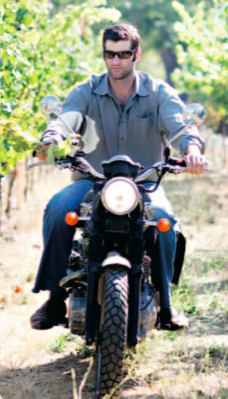
The Double Decker winemaking team is young enough to connect well with its audience. Thirty-something winemaker Karl Wente is the fifth generation of his family to be riding the vineyards on their Livermore, California property. The flagship winery dates back to 1883, and has been a leader in California winemaking all along (ever heard of Wente Clone Chardonnay?)
For the Double Decker project, they source fruit other vineyards, with some pretty impressive results. Let’s get to it.
Double Decker Pinot Grigio 2010 makes me think of Europe, not California. Made with fruit sourced from cool-climate Arroyo Seco, it shows its stuff right off the bat with a nose of delicate pear and pretty florals. The palate led with some tropical notes, but quickly showed some spice and snap. What lingered on my palate was tangy acidity — a clean, refreshing finish.
I (and several other bloggers) talked to Karl about the wine through a streaming online event (which is also very cool, by the way). He shared some of his winemaking secrets: one of those is that he blends a few percentage points of Riesling and Viognier into his Pinot Grigio. Karl says that these floral, aromatic grapes don’t really announce their presence, but just accentuate the fruit character of the Pinot Grigio.
He goes even further in his pursuit of balance: like the European winemakers, he picks his grapes at a lower brix (that means, when the sugar levels are lower) so that the wine will retain that bright natural acidity.
Yup, it all worked very well for me.
Big, Bigger, Biggest: Martin Family Dry Creek Cabernet Sauvignon 2009
April 14th, 2012 | Author: The WineLady
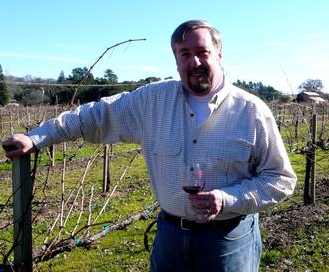
Meet Mike Martin...
OK, this one’s for all you lovers of unabashedly, un-apologetically New-World-style wines.
I mean wines with boatloads of fruit and voluptuous textures that don’t feel obliged to meet Old World standards of restraint or delicacy. (Can you tell I’ve been hanging out with way too many Euro-phile wine drinkers?)
The wine that sent me over the edge last night was Martin Family Dry Creek Cabernet Sauvignon 2009. It comes from a small-production, family-owned winery that, “is basically a passionate hobby that’s gotten a bit out of hand…. sort of like starting out collecting baseball cards and then one day realizing you own a major league ball team,” according to Jim Morris, vineyard manager.
Mike Martin, owner and winemaker, got the ball rolling by making wines for family and friends. They were a thirsty lot, and “because they wanted more free wine,” he made more. Then he planted a vineyard and contracted with some of the best growers in the Dry Creek Valley. He now produces about 4,000 cases of big reds (Cab, Zinfandel and Syrah) from vineyards in this northern Sonoma County appellation.
The lazy waterway called Dry Creek is a tributary of the Russian River, which all you Pinot Noir freaks know is the epicenter of a cool-climate region that produces some of America’s best Pinot and Chardonnay. The Dry Creek Valley AVA lies just north of the Russian River Valley, but has a very different micro-climate. Because its topography lies above the fog line, Dry Creek grapes begin each day in sunshine and cool-ish temperatures that warm considerably through the afternoon. A return to cool temps at night builds the structure that keeps Dry Creek fruit from becoming jammy.
Mike Martin takes it one step further: “the fruit for our wines is primarily from steep, rocky, hillside vineyards that produce super-concentrated, intense fruit flavors.”
Now I get it: that’s why the ripe, round aromas of blackberries jumped right out of the bottle, followed by rich mocha when it hit my glass. The color was deep garnet and almost opaque, showing good extraction and concentration.
The palate didn’t waste any time revealing gobs of rich blackberry and dark cherry fruit, along with some vanilla oak and chocolate. But just when all this opulence threatened to become jammy, the acid kicked in, brightening and cleansing the flavors. And right behind that were the well-integrated tannins that added depth and dimension.
This is what balance is all about, right? We can have our big up-front fruit and 14.8% ABV (that’s what the bottle says!) as long as we cool it down with proper acid and tannic structure.
Did I mention that all this goes for under $20? Yes, you can share the love for what I consider to be a bargain-basement price for wine of this quality. My next mission is to find the Martin Family Syrah — I can’t wait to see what they do with that grape… Cheers!
The Best of the Pacific Northwest: Sineann Abondante 2009
March 9th, 2012 | Author: The WineLady

Peter Rosback of Sineann Winery
How does this guy do it?
How does he produce so many great wines in such a dizzying variety of styles. How can one guy be responsible for all these:
A) Incredibly rich Old Vine Zinfandel;
B) Crisp and snappy New Zealand Sauv Blanc;
C) Bold but elegant single vineyard Willamette Valley Pinot Noirs; and
D) Intense but polished Washington State red blends.
And did I mention this guy has earned several boatloads of 90+ scores for all these disparate styles??
His name is Peter Rosback, master of Sineann Winery. He’s physically located in the Chehalem Mountains AVA near Newberg, Oregon, but his grapes come from all over the place. He’s one of the new breed of winemakers who doesn’t rely on owning acres of vineyards to produce estate-grown wines, but sources grapes from the best vineyards he can lay his hands on. Peter uses fruit from vineyards in Oregon, the Columbia Valley, and even Marlborough, New Zealand. (Yes, he flies halfway around the world to make his Sauv Blanc!)
It’s a smart approach these days, when you have to be a retired football star or race car driver to be able to pony up the multi-$100,000 per acre it takes to plant your own vineyards, and then pay vineyard workers and winemaking staff for seven or so years before you can actually sell any wine. Instead of owning land, Peter locates pedigreed vineyards and then “works closely with” (read, “drives crazy”) his growers to produce the best fruit possible. It’s a way of doing business that allows Peter tremendous flexibility as a winemaker, while still maintaining control over his product.
But if you could say there’s a signature style to all of Peter’s wines, it would probably be intensity of fruit and concentration of flavors. Aha! That’s one of the things Peter creates in the vineyards. He works with his growers to reduce crop yields way below most premium or super-premium wines: he goes as low as one ton per acre. Trust me, that’s LOW! (A premium Napa Valley grape grower might harvest two and a half to three tons per acre).
 So why does he do it? The short answer is that reducing the number of grapes each vine produces greatly increases the concentration and intensity of flavor in every single grape. And believe me, it shows in Peter’s wine.
So let’s get to the wine. I recently went nuts over the Sineann Abondante 2009, a red blend made with fruit from vineyards in the lower Columbia Valley. Now I have to admit that I ordered this wine without ever tasting or even reading about it: I just figured that I’d love anything from the winemaker who’d made the amazing Sineann Resonance Vineyard Pinot Noir (with scores in every vintage hovering near the mid-90′s).
So I poured Abondante at a wine and food pairing dinner, where I’d made an admittedly wild-ass guess about how the wine would taste and pair with my food. Truthfully, I just wanted to drink it. The wine is an intriguing blend of grapes grown in the Columbia Valley. There is Merlot from the Hillside Vineyard, Cabernet Franc from the famed Champoux Vineyard, Cabernet Sauvignon from the Hillside Vineyard and Zinfandel (yes, Washington State Zinfandel) from vineyards that are reputed to be the oldest in the Pacific Northwest.
Wild, huh?
And it does honor to its name. “Abondante” means “generous,” and those abundant flavors jump right out of the glass. There’s rich berry fruit, which may be contributed by the old vine Zinfandel. There are floral and herbal notes (maybe from the Cab Franc?) as well as some plum and pomegranate. All of this is wrapped up in soft tannins and a round ripeness, but not jamminess, that smooths out the finish.
That’s what I liked best: intensity without weight. The fruitiness and structure all danced happily together, creating a very lithe and refined wine that just happened to be rich in fruit flavors.
This wine was kick-ass. And the good news is that it worked perfectly with Beef Filet Medallions topped with Gorgonzola and a Red Wine Reduction. Who would have thought? Like I said, I just wanted to taste the wine…
Try hard to find a bottle of 2009 Abondante, although it’ll be tough given Sineann’s small production and the ridiculously low price for this wine ($30 in my state). But do your best, because you’ll go nuts like I did… Cheers!
Gary Farrell, Master of Balance
February 15th, 2012 | Author: The WineLady
Wow! We were perusing the wine list at a local wine bar when we saw, “Alysian by Gary Farrell.”
What?? What’s this new name from a winemaker we’ve been following for years?
If you’re a Pinot Noir lover, and you haven’t been living under a rock for the last 10 years, you’ve seen Gary Farrell’s name on some of the top-rated and best-selling Pinot’s coming out of Sonoma County’s Russian River Valley. The winery he used to own, perched high on a wooded hillside overlooking the river, produced some absolutely classic Pinot Noir that helped define the style for this Northern California appellation.
But we knew that he sold his name-sake winery in 2004, and hadn’t been heard from since…until the non-compete clause was satisfied. So that’s why I ran into “Alysian by Gary Farrell.”
And I was I glad I did. I haven’t enjoyed such classic Pinot in a long time.
This wine, the 2008 Alysian Russian River Selections Pinot Noir, is part of Gary’s new project. But it’s not exactly new — over the past three decades, Gary has forged links with all the finest grape growers in the valley, and established a reputation that puts him at the top of his class. So when he wanted to go back to his roots, making small-lot, super-premium wines from the best vineyards, he just needed to pick up the phone…
In the Russian River Selection, he uses fruit from five great Russian River vineyards, including the Richioli and Allen vineyards. And the style is as classic as the vineyards.
The nose set the tone with delicate aromas of black cherry pie filling and baked caramel. Now I know that sounds pretty rich, but you have to understand the style — you get all these rich “goodies” wrapped up in a restrained, balanced package.
The palate revealed more. My first sip gave me a burst of bright black cherry fruit, and the acid kicked in right behind it. There was no “tooty-fruity, jammy” character — the stellar balance kept all the elements working in harmony.
More flavors jumped up and waved hello as the wine sat in my glass. I got some baking spice, some vanilla, some mocha — but all controlled by that nice, laser-beam acid balance. To me, this is as good as wine gets: intensity without weight.
It’s great to drink a bottle of wine that doesn’t exhaust your palate with too much fruit and alcohol. Now don’t get me wrong — I’m as much of a hedonist as the next guy, and can enjoy a glass or two of a big fruit bomb. But only a glass or two. Gary Farrell’s Pinot could be savored all night long.
Which is what I did. At least until the bottle gave out. Find this bottle, if you can, and enjoy it for yourself. Cheers!
Meet the Temecula Valley: Wiens wines
February 1st, 2012 | Author: The WineLady
Have you ever heard of Temecula wines? No? That’s what I thought…
American wine drinkers (at least those who live east of the California state line) have never heard of the region.
Which is really ironic, because the Temecula Valley lies just a stone’s throw from where the whole California wine thing got started — sometime around 1820.
Wine grapes were first brought to California by Spanish missionaries, who built a string of missions along the California coast to bring Christianity to the heathens. Remember that thing about the swallows coming back to San Juan Capistrano? Well, San Juan Capistrano was the first mission, and it was built a mere 18 miles west of present day Temecula. The good monks grew Mission grapes and made sweet, fortified wine for communion (or whatever…).
So fast-forward to modern-day Southern California. The region is now known for congested freeways and movie stars, but some savvy winemakers have discovered that the Temecula Valley has conditions that are amazingly favorable for high-quality wine grapes. Check this out:
Temecula sits on a plateau at about 1,400 feet elevation, snugged up to a higher mountain range. Mists linger until mid-morning, helping to cool the region. Cold air also gets sucked in from the Pacific Ocean through gaps in the coastal mountains, creating ideal micro-climates for high-quality wine grapes.

The four Wiens brothers, plus mom
Is this ringing a bell? Does this sound like the conditions that make Napa, Sonoma, and Santa Barbara such great regions for wine grapes?
On top of the above, the surrounding mountains create “rivers” of cold air that drift down over Temecula, creating a double cooling effect.
But wait — that’s not all! Because the area is further south than, say, San Francisco, the vineyards are closer to the Equator and receive more radiant heat. So OK, we have that wonderful “warm days, cold nights” thing happening, plus relatively little rainfall during the growing and harvest season. Soils, too, are well drained, producing clean, pure varietal flavors.
So this looks like a recipe for great wine. It makes me wonder why all of us non-Temeculties took so long to discover this little wine region. My excuse is that I hadn’t tasted any of their wines — at least until a few nights ago, when a friend brought over a bottle from Wiens Family Cellars. Not being one to turn down free alcohol, we popped the cork and… enjoyed!
We were drinking Wiens 2008 Tempranillo-Petite Sirah. That’s an unusual (or even unheard-of) blend. Who ever thought to combine this Spanish grape with California’s big, bold, dense, brooding varietal?
But I gotta tell you — someone should have thought of it sooner. My first sip was enough to make me say, “Of course!” It’s a great idea to use the bright fruit and crisp acidity of Tempranillo to tame the often-too-heavy Petite Sirah.
When I poured the Wiens, the color looked very “Petite.” It was opaque and red/pourple, and I geared myself for a big, big wine. The nose, however, showed some bright cherry up front, followed by some heavier caramel and dark berry notes.
The palate was a happy marriage of both grapes. I loved how the acid from the Tempranillo cut the heaviness of the Petite Sirah, and made this a pretty decent food wine. I got more complexity, too, as it sat and breathed, with nice brambly notes, mocha and vanilla creeping in.
Wiens Tempranillo-Petite Sirah is a well-made wine, and it’s fun to drink. It’s kinda pricey at $50 a bottle — I assume that’s one of the unfortunate repercussions of operating a small-production facility in a place like Temecula. But I wish the folks at Wiens the best — they’re doing a good job and helping to put the Temecula Valley on the wine map. I’ll tip my hat to the ghosts of San Juan Capistrano, and say, Cheers!
Gold Rush Wine: Sobon Zinfandel
January 30th, 2012 | Author: The WineLady
Meet winemaker Paul Sobon
If I asked, “What do you know about California’s Amador County?”, a history buff would say, “It’s Gold Rush Country.” The average wine drinker would say, “Huh?”
That’s a pity. Amador County was not only home to folks like John Sutter, who launched the Gold Rush when he found gold in Sutter’s Creek, but to some of the oldest Zinfandel vines in America. And those vines make some mighty good wine…
Those vines were probably planted by European immigrants who came to California to strike it rich. A few did, and many more didn’t. But they left a legacy — Amador’s old Zinfandel vines — that we’re still enjoying today.
Amador County, lying east of Sacramento in the foothills of the Sierra Nevada Mountains, turned out to be a wonderful place to plant grape vines. The soil, the warm days and cool nights of this micro-climate, and the positive effects of elevation produce intensely flavored, well-structured wines.
I rediscovered Amador recently when I met Paul Sobon, second-generation winemaker and owner of Sobon Estate and Shenandoah Vineyards. His parents, Leon and Shirley, bought land in the Shenandoah Valley appellation 35 years ago. They purchased the historic D’Agostini Winery a dozen years later, and continued to produce killer Zins, as well as Rhone varietals.
I recently tasted the Sobon Estates 2008 Fiddletown Zinfandel. I expected a big, port-like fruit bomb. What I got instead was great fruit with great balance. This, to me, is as good as Zin gets…
The fruit for Sobon’s Fiddletown Zin comes from the Lubenko Vineyard, which sits at 1900 feet elevation. The vines were planted in 1910, which makes them mighty old vines. I figured they’d bring some great flavors to this wine.
The good stuff started with the nose: it jumped at me out of the glass, with blueberry compote and raspberry liqueur. Doesn’t sound very restrained, does it? But remember that I said this wine was balanced, not tame.
The wine in my mouth exploded with essence of blueberry, followed by round mocha notes. A few minutes later some black raspberry joined the party. Just when I was thinking that this was way too much fun, the acid kicked in, knocking the heat off the back end and allowing the well-integrated oak and tannins to carry the finish.
Not bad! I never thought Sobon Fiddletown was too jammy or port-like. It was big, for sure, but didn’t overwhelm my senses. I’m glad, though, that I tasted a 2008 — I think the three or four years of age gave it time to grow up and settle down.
Paul Sobon makes well over a dozen wines, so make it a point to find some. The price points are good (the Fiddletown goes for around $20 and many are closer to $10). And don’t forget his Cal-Ital varietals: they’ll knock your socks off, too, and you can read what I wrote about them here. Cheers!
